Food Banks Listed for Orange County, North Carolina
We found 4 food banks listed for Orange County, North Carolina. Call before you go to confirm hours and what to bring. You can also see food pantries in Orange County, North Carolina.
Food Bank of Central & Eastern North Carolina - Durham Branch
Phone: (919) 956-2513
Address: 2700 Angier Ave Ste A, Durham, NC 27703. Get Directions
Hours: Call for hours
The Durham Branch of the Food Bank of Central & Eastern North Carolina serves 6 counties including Chatham, Durham, Granville, Orange, Person, and Vance. In these counties, more than 106,990 people live in food insecure households, 30,750 of whom are children. Last year we distributed more than 7.6 million pounds of food to our network of 173 partner agencies in the local community. Our volunteers at the branch served 30,132 hours, the equivalent to approximately 14 full-time employees. For every dollar donated, we can provide 5 meals to the Bull City community! Get involved today by making a donation, signing up to volunteer, or hosting a food drive!
Services provided :
- food pantry
Appointments :
Call (919) 956-2513 to ask about hours, whether you need an appointment, and what to bring.
Help Residents of Cities:
- Durham
Help Residents of Counties:
- Wake
- Orange
- Alamance
- Chatham
- Franklin
- Durham
- Vance
- Granville
- Person
Comunidad Cristiana Hosanna - Agape Food Bank
Phone: (919) 834-4122
Address: 204 Shelden Dr, Raleigh, NC 27610. Get Directions
Hours: Call for hours
Comida gratis el Primer y Tercer Viernes de cada mes a las 10:00 AM
Services provided :
- food pantry
Appointments :
Call (919) 834-4122 to ask about hours, whether you need an appointment, and what to bring.
Help Residents of Cities:
- Raleigh
Help Residents of Counties:
- Wake
- Chatham
- Orange
- Johnston
- Franklin
- Durham
- Wilson
- Granville
- Harnett
- Nash
Food Bank of Central & Eastern North Carolina
Phone: (919) 875-0707
Address: 3808 Tarheel Dr, Raleigh, NC 27609. Get Directions
Hours: Call for hours
Established in 1980, the Food Bank of Central & Eastern North Carolina a nonprofit organization that has provided food for people at risk of hunger in 34 counties in central and eastern North Carolina for over 30 years. The Food Bank serves a network of more than 800 partner agencies such as soup kitchens, food pantries, shelters, and programs for children and adults through distribution centers in Durham, Greenville, New Bern, Raleigh, the Sandhills (Southern Pines) and Wilmington. In fiscal year 2012-2013, the Food Bank distributed nearly 52 million pounds of food and non-food essentials through these agencies. Sadly, hunger remains a serious problem in central and eastern North Carolina. In these counties, more than 560,000 struggle each day to provide enough food for their families. Nearly 30 percent of the people served by the Food Bank’s network are children, and another 8 percent are elderly. 30 percent of the families served are the “working poor†people who work hard and still have to choose between eating and other basic necessities such as medicine and housing.
Services provided :
- food pantry
Appointments :
Call (919) 875-0707 to ask about hours, whether you need an appointment, and what to bring.
Help Residents of Cities:
- Raleigh
Help Residents of Counties:
- Wake
- Chatham
- Orange
- Johnston
- Franklin
- Durham
- Wilson
- Granville
- Harnett
- Nash
Church Food Banks in Orange County, North Carolina
Some churches in and around Orange County, North Carolina run food banks or serve free meals.
Many welcome anyone who needs a meal. Some also offer services such as showers, laundry, mail, or I.D. assistance, so call ahead to confirm what is available.
Russell Memorial CME Church - Food Bank Ministry
Phone: (919) 682-2523
Address: 703 S Alston Ave, Durham, NC 27701. Get Directions
Hours: Call for hours
We provide food assistance to local individuals and families who need assistance. Groceries often include non perishable items, which can be donated. You can call the church office to set up an appointment for donations or get more information on the criteria for qualifications.
Services provided :
- food pantry
Appointments :
Call (919) 682-2523 to ask about hours, whether you need an appointment, and what to bring.
Help Residents of Cities:
- Durham
Help Residents of Counties:
- Wake
- Orange
- Alamance
- Chatham
- Franklin
- Durham
- Vance
- Granville
- Person
Food prices remain high. The FAO Food Price Index averaged 136.0 points in September 2026, up 5.8% from a year earlier.
A 36% price increase over the 2014-2016 base period shows that hunger is a public health issue of critical importance.
The most vulnerable demographic of society is taking the brunt of this economic pressure. Now more than ever, low-income families must rely on North Carolina Free Clinics, North Carolina Food Stamps, and food banks.
This guide will list helpful information about food banks in Orange County, North Carolina and organizations that can help curb hunger, how you can use their services and where to find them.
What is a Food Bank?
Food banks are non-profit charitable organizations that assist financially vulnerable populations by distributing food. Their main objective is to help low-income individuals and families by providing food.
They will work through other 501(c)(3) non-profit organizations like food pantries and soup kitchens. Sometimes they distribute the food themselves via mobile pantry.
A food bank in Orange County, North Carolina serves as a single collection and distribution point for food donations. They operate much like a for-profit food distributor, but they do not use retailers. Instead, they may use church food banks, charities, and other non-profit food pantries to provide food to the people to fight hunger.
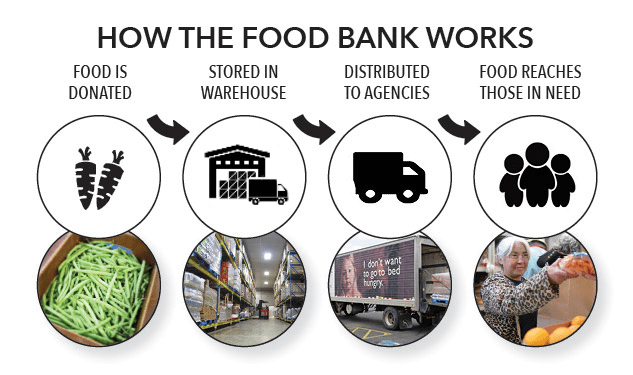
How the Food Bank Works?
- 1. Food is donated to a food bank.
- 2. It is stored in a large climate-controlled warehouse.
- 3. A food bank in Orange County, North Carolina distributes food to various non-profits for distribution.
- 4. Food reaches people who are in need.
Who can use Food Banks?
Many food banks and food pantries in Orange County, North Carolina are locally run, with others managed at the state or federal level. Qualification to receive nutrition assistance from food programs depends on the type.
There are different qualifying requirements, and some food banks have none. Some let you come during their days and times of operation, and they will help if they are able.
Here are some tips before you go:
- It is highly advisable to call ahead before you arrive!
- Ask about any eligibility or documentation requirements they may have.
- If required, bring all required documents when you use their services.
Second Harvest Food Bank
Many communities across the United States are served by food banks that use the Second Harvest name.
These food banks help families facing hard choices between food, housing, medicine, and other necessities. We don't have a food bank with the Second Harvest name listed for Orange County, North Carolina right now.
Feeding America
John van Hengel, the founder of St. Mary's Food Bank, went on to create a national organization for food banks. The Feeding America organization is a leader in the nation's domestic hunger-relief efforts.
High food costs continue to put pressure on America's most vulnerable citizens. Feeding America reports that its network provides 5.9 billion meals a year.
The Feeding America network has grown through donations and other charitable efforts to be able to deliver much-needed food via food rescue, hunger relief programs, and disaster response.
A listing on this page doesn't mean an organization is part of the Feeding America network. To find a member food bank, use Feeding America's finder.
The Supplemental Nutrition Assistance Program (SNAP)
The Supplemental Nutrition Assistance Program (SNAP) is a federal program that helps obtain badly needed food for low-income people and families. SNAP is also known as Food Stamp.
Nationally, SNAP served approximately 42 million Americans per month in fiscal year 2025. To ask about SNAP benefits in Orange County, North Carolina, contact your state SNAP office. It is the most extensive nutrition program administered by Food and Nutrition Service (FNS) and is a vital component of the social safety net for low-income Americans.
In fiscal year 2025, about 12.3% of the U.S. population received SNAP benefits in an average month.
The program had used paper "stamps" or coupons in the past – worth $1 (brown), $5 (blue), and $10 (green). These were bound into small booklets of various denominations, to be torn out individually and used in single-use exchanges.
Free Food Programs Summary
| Acronym | Name | For Moms & Kids | For Seniors | For Food Bank |
|---|---|---|---|---|
| SNAP | Supplemental Nutrition Assistance Program | Yes | Yes | No |
| TEFAP | The Emergency Food Assistance Program | Yes | Yes | Yes |
| CSFP | The Commodity Supplemental Food Program | No | Yes | Yes |
| CACFP | The Child and Adult Care Food Program | Yes | Yes | No |
| NSLP | The National School Lunch Program | Yes | No | No |
| SBP | The School Breakfast Program | Yes | No | No |
| SFSP | The Summer Food Service Program | Yes | No | No |
| WIC | Women, Infants, and Children | Yes | No | No |
FAQ (Frequently Asked Questions)
1. What is the difference between a food bank and a food pantry?
Independent community food pantries are self-governing and usually distribute food to their clients on a once-a-month basis. A food bank is the storehouse for millions of pounds of food and other products that go out to the community. A food pantry functions as the arms that reach out to that community directly.
2. What kind of food is at a food bank?
Orange County food banks often have items like:
- Peanut butter
- Canned soup
- Canned fruit
- Canned vegetables
- Pasta
- Canned beans
- Canned stew
- Canned fish
3. How do you qualify for Orange County food bank assistance?
Requirements vary, and some food banks and pantries ask for no paperwork at all. Call ahead. Some may ask you to bring:
- A state-issued ID
- Social Security numbers of household members
- A bill or other mail that shows your address
- Proof of income, such as a bank statement