Food Banks Listed for Laporte County, Indiana
We found 2 food banks listed for Laporte County, Indiana. Call before you go to confirm hours and what to bring. You can also see food pantries in Laporte County, Indiana.
Food Bank of Northwest Indiana, Inc.
Phone: (219) 980-1777
Address: 2248 W 35th Ave, Gary, IN 46408. Get Directions
Hours: Call for hours
The Food Bank of Northwest Indiana was founded in 1982. It was originally a barn, but has grown into a facility that acquires, stores and distributes over 4.9 million pounds of food throughout Lake and Porter Counties. It is a USDA approved, primary distributor of food to local pantries, shelters, day care centers, and soup kitchens. The Food Bank is an affiliate of Feeding America, the nation's largest food bank network. For more than three decades, the Food Bank has served as a link for food relief to families, the elderly, children and other individuals. The Food Bank of Northwest Indiana's mission is to provide nutritional support to those in need of hunger relief through its network of 100 community agencies across Lake and Porter Counties--with the ongoing focus of ending hunger and helping individuals in our community move towards self-sufficiency.
Services provided :
- food pantry
Appointments :
Call (219) 980-1777 to ask about hours, whether you need an appointment, and what to bring.
Help Residents of Cities:
- Gary
Help Residents of Counties:
- Lake
- LaPorte
- Porter
Church Food Banks in Laporte County, Indiana
Some churches in and around Laporte County, Indiana run food banks or serve free meals.
Many welcome anyone who needs a meal. Some also offer services such as showers, laundry, mail, or I.D. assistance, so call ahead to confirm what is available.
Church Community Services - Food Bank of Elkhart County
Phone: (574) 295-3673
Address: 907 Oakland Ave, Elkhart, IN 46516. Get Directions
Hours: Call for hours
The Food Bank of Elkhart County is a food supply source for the many food pantries and hot meal sites throughout Elkhart County. FBEC began in the spring of 2013 through a partnership with the Food Bank of Northern Indiana as a way to help keep local food donations within our own community. Monday – Friday 9:00am – 2:00pm
Services provided :
- food pantry
Appointments :
Call (574) 295-3673 to ask about hours, whether you need an appointment, and what to bring.
Help Residents of Cities:
- Elkhart
Help Residents of Counties:
- Elkhart
- St. Joseph
- Kosciusko
- Marshall
- LaPorte
Food prices remain high. The FAO Food Price Index averaged 136.0 points in September 2026, up 5.8% from a year earlier.
A 36% price increase over the 2014-2016 base period shows that hunger is a public health issue of critical importance.
The most vulnerable demographic of society is taking the brunt of this economic pressure. Now more than ever, low-income families must rely on Indiana Free Clinics, Indiana Food Stamps, and food banks.
This guide will list helpful information about food banks in Laporte County, Indiana and organizations that can help curb hunger, how you can use their services and where to find them.
What is a Food Bank?
Food banks are non-profit charitable organizations that assist financially vulnerable populations by distributing food. Their main objective is to help low-income individuals and families by providing food.
They will work through other 501(c)(3) non-profit organizations like food pantries and soup kitchens. Sometimes they distribute the food themselves via mobile pantry.
A food bank in Laporte County, Indiana serves as a single collection and distribution point for food donations. They operate much like a for-profit food distributor, but they do not use retailers. Instead, they may use church food banks, charities, and other non-profit food pantries to provide food to the people to fight hunger.
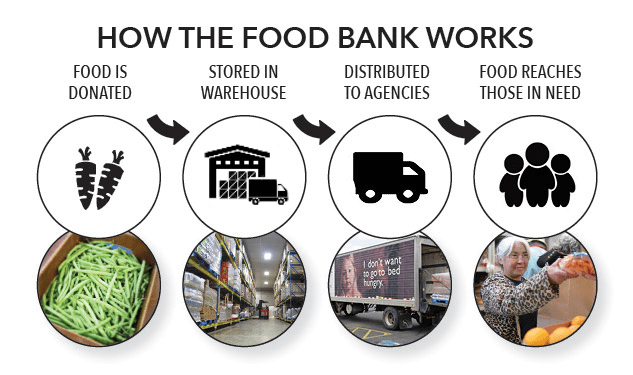
How the Food Bank Works?
- 1. Food is donated to a food bank.
- 2. It is stored in a large climate-controlled warehouse.
- 3. A food bank in Laporte County, Indiana distributes food to various non-profits for distribution.
- 4. Food reaches people who are in need.
Who can use Food Banks?
Many food banks and food pantries in Laporte County, Indiana are locally run, with others managed at the state or federal level. Qualification to receive nutrition assistance from food programs depends on the type.
There are different qualifying requirements, and some food banks have none. Some let you come during their days and times of operation, and they will help if they are able.
Here are some tips before you go:
- It is highly advisable to call ahead before you arrive!
- Ask about any eligibility or documentation requirements they may have.
- If required, bring all required documents when you use their services.
Second Harvest Food Bank
Many communities across the United States are served by food banks that use the Second Harvest name.
These food banks help families facing hard choices between food, housing, medicine, and other necessities. We don't have a food bank with the Second Harvest name listed for Laporte County, Indiana right now.
Feeding America
John van Hengel, the founder of St. Mary's Food Bank, went on to create a national organization for food banks. The Feeding America organization is a leader in the nation's domestic hunger-relief efforts.
High food costs continue to put pressure on America's most vulnerable citizens. Feeding America reports that its network provides 5.9 billion meals a year.
The Feeding America network has grown through donations and other charitable efforts to be able to deliver much-needed food via food rescue, hunger relief programs, and disaster response.
A listing on this page doesn't mean an organization is part of the Feeding America network. To find a member food bank, use Feeding America's finder.
The Supplemental Nutrition Assistance Program (SNAP)
The Supplemental Nutrition Assistance Program (SNAP) is a federal program that helps obtain badly needed food for low-income people and families. SNAP is also known as Food Stamp.
Nationally, SNAP served approximately 42 million Americans per month in fiscal year 2025. To ask about SNAP benefits in Laporte County, Indiana, contact your state SNAP office. It is the most extensive nutrition program administered by Food and Nutrition Service (FNS) and is a vital component of the social safety net for low-income Americans.
In fiscal year 2025, about 12.3% of the U.S. population received SNAP benefits in an average month.
The program had used paper "stamps" or coupons in the past – worth $1 (brown), $5 (blue), and $10 (green). These were bound into small booklets of various denominations, to be torn out individually and used in single-use exchanges.
Free Food Programs Summary
| Acronym | Name | For Moms & Kids | For Seniors | For Food Bank |
|---|---|---|---|---|
| SNAP | Supplemental Nutrition Assistance Program | Yes | Yes | No |
| TEFAP | The Emergency Food Assistance Program | Yes | Yes | Yes |
| CSFP | The Commodity Supplemental Food Program | No | Yes | Yes |
| CACFP | The Child and Adult Care Food Program | Yes | Yes | No |
| NSLP | The National School Lunch Program | Yes | No | No |
| SBP | The School Breakfast Program | Yes | No | No |
| SFSP | The Summer Food Service Program | Yes | No | No |
| WIC | Women, Infants, and Children | Yes | No | No |
FAQ (Frequently Asked Questions)
1. What is the difference between a food bank and a food pantry?
Independent community food pantries are self-governing and usually distribute food to their clients on a once-a-month basis. A food bank is the storehouse for millions of pounds of food and other products that go out to the community. A food pantry functions as the arms that reach out to that community directly.
2. What kind of food is at a food bank?
Laporte County food banks often have items like:
- Peanut butter
- Canned soup
- Canned fruit
- Canned vegetables
- Pasta
- Canned beans
- Canned stew
- Canned fish
3. How do you qualify for Laporte County food bank assistance?
Requirements vary, and some food banks and pantries ask for no paperwork at all. Call ahead. Some may ask you to bring:
- A state-issued ID
- Social Security numbers of household members
- A bill or other mail that shows your address
- Proof of income, such as a bank statement