Phone: (860) 295-6008
Address: 3 Wilhenger Dr, Marlborough, CT 06447. Get Directions
Hours: Call for hours
The Food Bank of Marlborough serves qualified residents of Marlborough, Connecticut. The hours of operation are 10 am to noon and 3:30 to 5:30 pm on Tuesdays, and the first Saturday of each month from 10 am to noon (donations only). Additionally, donations can be taken to the food drop off box at Marlborough Town Hall (non-perishable items), or at the Marlborough Elementary School office, which will accept monetary donations or non-perishable items (hours: school year 8 am-4 pm: summer 8:30 am-3pm). Donations can also be made to the administrative office during open hours. Students are encouraged to bring donations to school for drop-off. The Food Bank of Marlborough is now a 501(c)3 charitable organization, and is sponsored by the Congregational Church of Marlborough. The Food Bank of Marlborough is managed by Joanne Goode and Dave Wagner and is staffed by volunteers.
Services provided :
- food pantry
Help Residents of Cities:
- Marlborough
Help Residents of Counties:
- Windham
- New London
- Tolland
- New Haven
- Middlesex
- Hartford
- Litchfield
Appointments
Ask whether you need an appointment before you visit.
You can call (860) 295-6008 to ask about appointments, hours, and what to bring.
Food Bank in Near By County
Questions to Ask
Always call ahead and find out some basic information before you go to receive food.
- What are your hours of operation?
- Where can I pick up the food I need?
Document Requirements
Please ask about any documents required to prove eligibility. Some of the questions to ask:
- Do I need to bring photo identification?
- Do I need to bring a piece of mail (like an electrical bill) that shows my name and address?
- Do I need to bring proof of income or bank account statements?
- Do I need to register for service, or is it "first come, first served"?
What is a Food Bank?
Food banks are non-profit charitable organizations that assist financially vulnerable populations by distributing food. Their main objective is to help low-income individuals and families by providing food.
They will work through other 501(c)(3) non-profit organizations like food pantries and soup kitchens. Sometimes they distribute the food themselves via mobile pantry.
A food bank serves as a single collection and distribution point for food donations. They operate much like a for-profit food distributor, but they do not use retailers. Instead, they may use church food banks, charities, and other non-profit food pantries to provide food to the people to fight hunger.
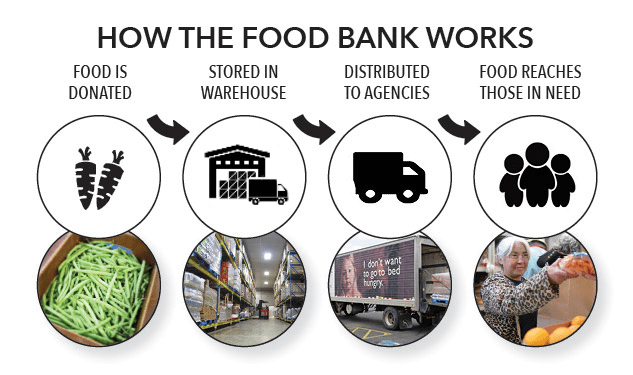
How the Food Bank Works?
- 1. Food is donated to a food bank.
- 2. It is stored in a large climate-controlled warehouse.
- 3. Food Bank distributes food to various non-profits for distribution.
- 4. Food reaches people who are in need.
Who can use Food Banks?
Many food banks and food pantries are locally run, with others managed at the state or federal level. Qualification to receive nutrition assistance from food programs depends on the type.
There are different qualifying requirements, and some food banks have none. Some let you come during their days and times of operation, and they will help if they are able.
Here are some tips before you go:
- It is highly advisable to call ahead before you arrive!
- Ask about any eligibility or documentation requirements they may have.
- If required, bring all required documents when you use their services.
Feeding America
John van Hengel, the founder of St. Mary's Food Bank, went on to create a national organization for food banks. The Feeding America organization is a leader in the nation's domestic hunger-relief efforts.
High food costs continue to put pressure on America's most vulnerable citizens. Feeding America reports that its network provides 5.9 billion meals a year.
The Feeding America network has grown through donations and other charitable efforts to be able to deliver much-needed food via food rescue, hunger relief programs, and disaster response.
A listing on this page doesn't mean an organization is part of the Feeding America network. To find a member food bank, use Feeding America's finder.
The Supplemental Nutrition Assistance Program (SNAP)
The Supplemental Nutrition Assistance Program (SNAP) is a federal program that helps obtain badly needed food for low-income people and families. SNAP is also known as Food Stamp.
Nationally, SNAP served approximately 42 million Americans per month in fiscal year 2025. To ask about SNAP benefits in Marlborough, contact your state SNAP office. It is the most extensive nutrition program administered by Food and Nutrition Service (FNS) and is a vital component of the social safety net for low-income Americans.
In fiscal year 2025, about 12.3% of the U.S. population received SNAP benefits in an average month.
The program had used paper "stamps" or coupons in the past – worth $1 (brown), $5 (blue), and $10 (green). These were bound into small booklets of various denominations, to be torn out individually and used in single-use exchanges.
Free Food Programs Summary
| Acronym | Name | For Moms & Kids | For Seniors | For Food Bank |
|---|---|---|---|---|
| SNAP | Supplemental Nutrition Assistance Program | Yes | Yes | No |
| TEFAP | The Emergency Food Assistance Program | Yes | Yes | Yes |
| CSFP | The Commodity Supplemental Food Program | No | Yes | Yes |
| CACFP | The Child and Adult Care Food Program | Yes | Yes | No |
| NSLP | The National School Lunch Program | Yes | No | No |
| SBP | The School Breakfast Program | Yes | No | No |
| SFSP | The Summer Food Service Program | Yes | No | No |
| WIC | Women, Infants, and Children | Yes | No | No |
FAQ (Frequently Asked Questions)
1. What is the difference between a food bank and a food pantry?
Independent community food pantries are self-governing and usually distribute food to their clients on a once-a-month basis. A food bank is the storehouse for millions of pounds of food and other products that go out to the community. A food pantry functions as the arms that reach out to that community directly.
2. What kind of food is at a food bank?
Marlborough food banks often have items like:
- Peanut butter
- Canned soup
- Canned fruit
- Canned vegetables
- Pasta
- Canned beans
- Canned stew
- Canned fish
3. How do you qualify for Marlborough food bank assistance?
Requirements vary, and some food banks and pantries ask for no paperwork at all. Call ahead. Some may ask you to bring:
- A state-issued ID
- Social Security numbers of household members
- A bill or other mail that shows your address
- Proof of income, such as a bank statement